-
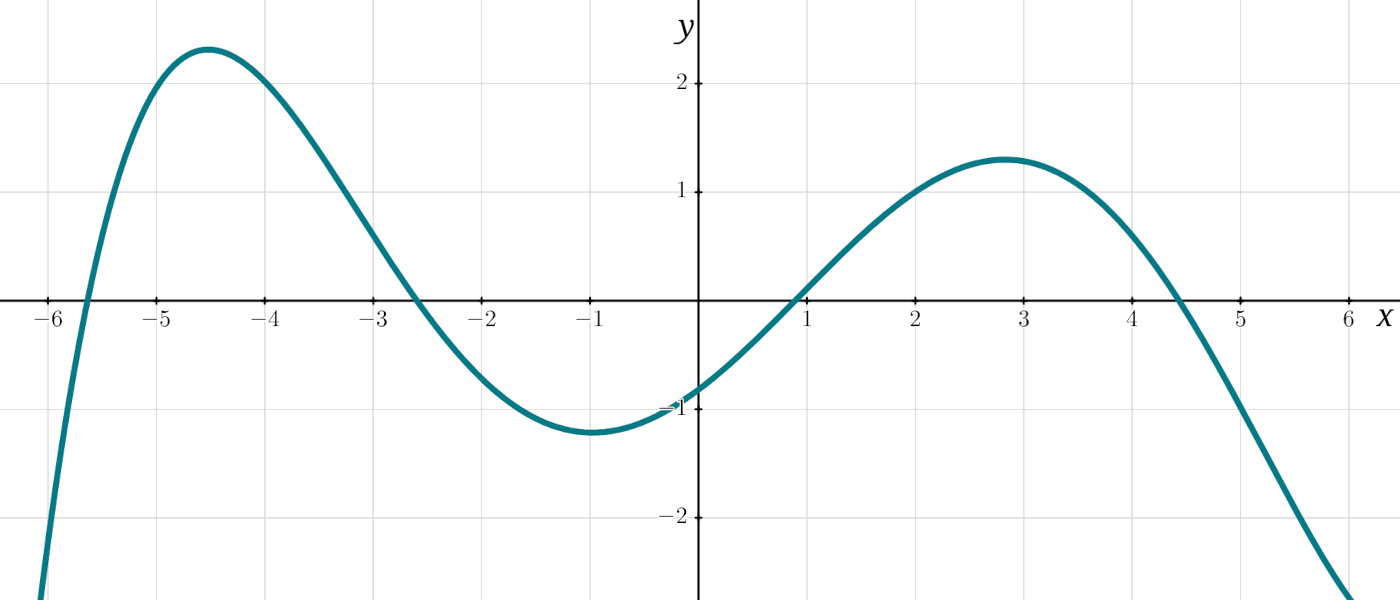
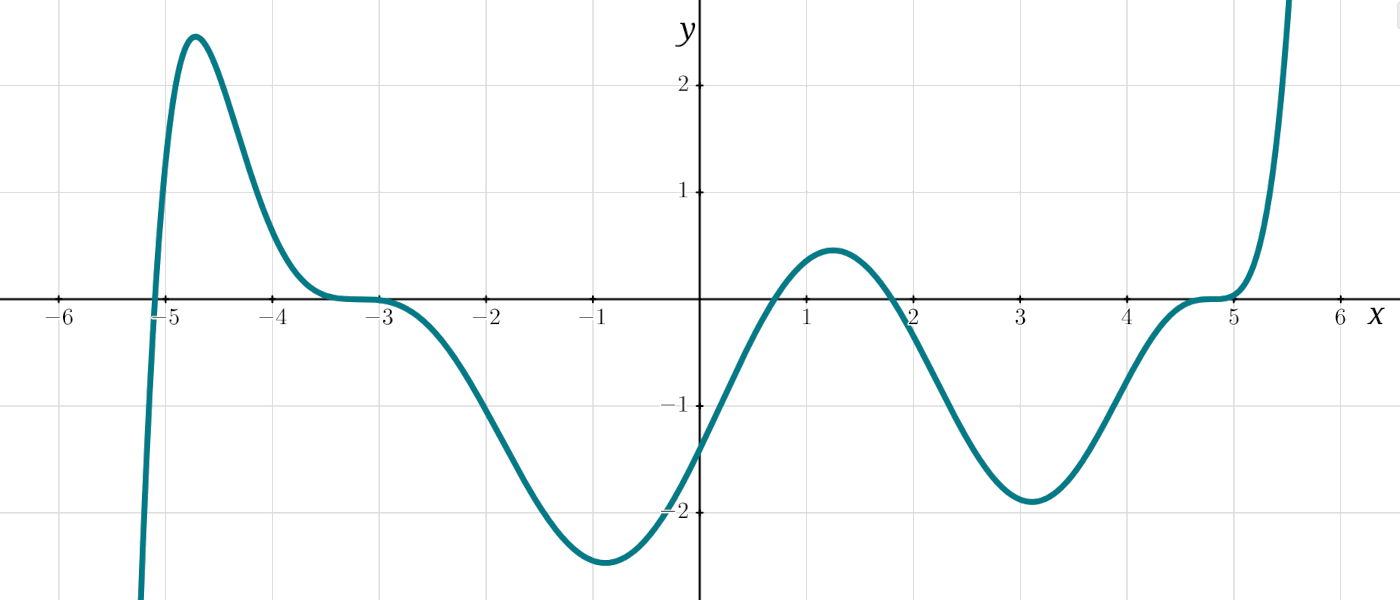
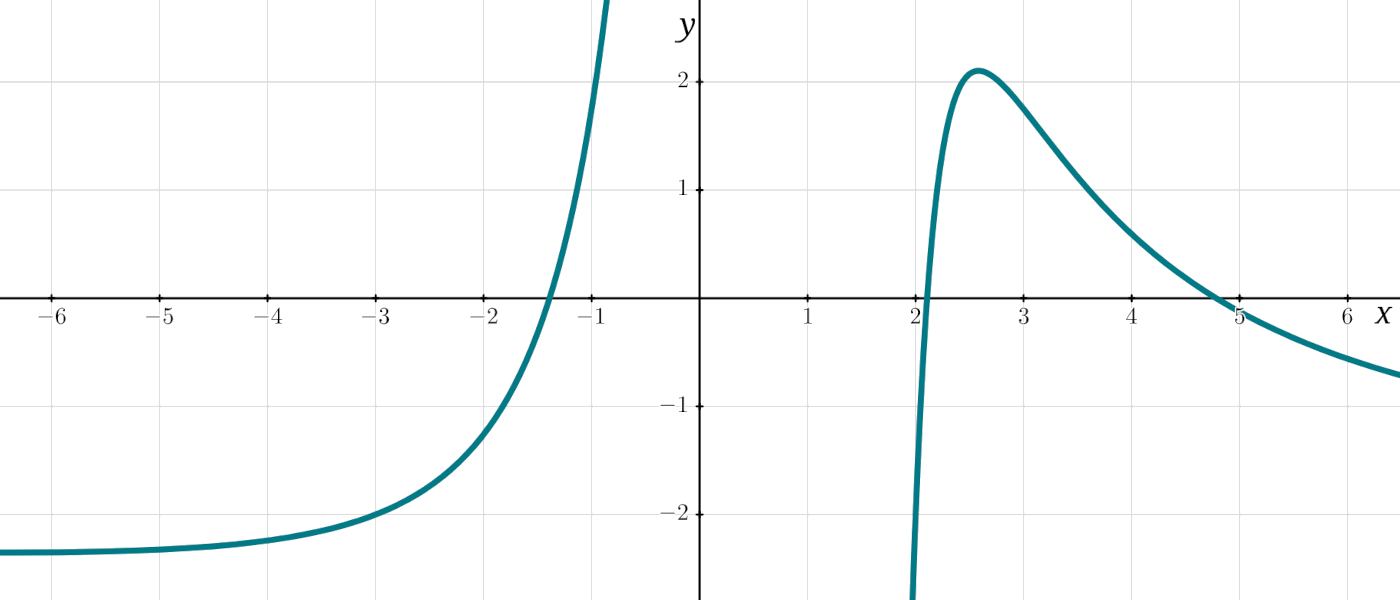
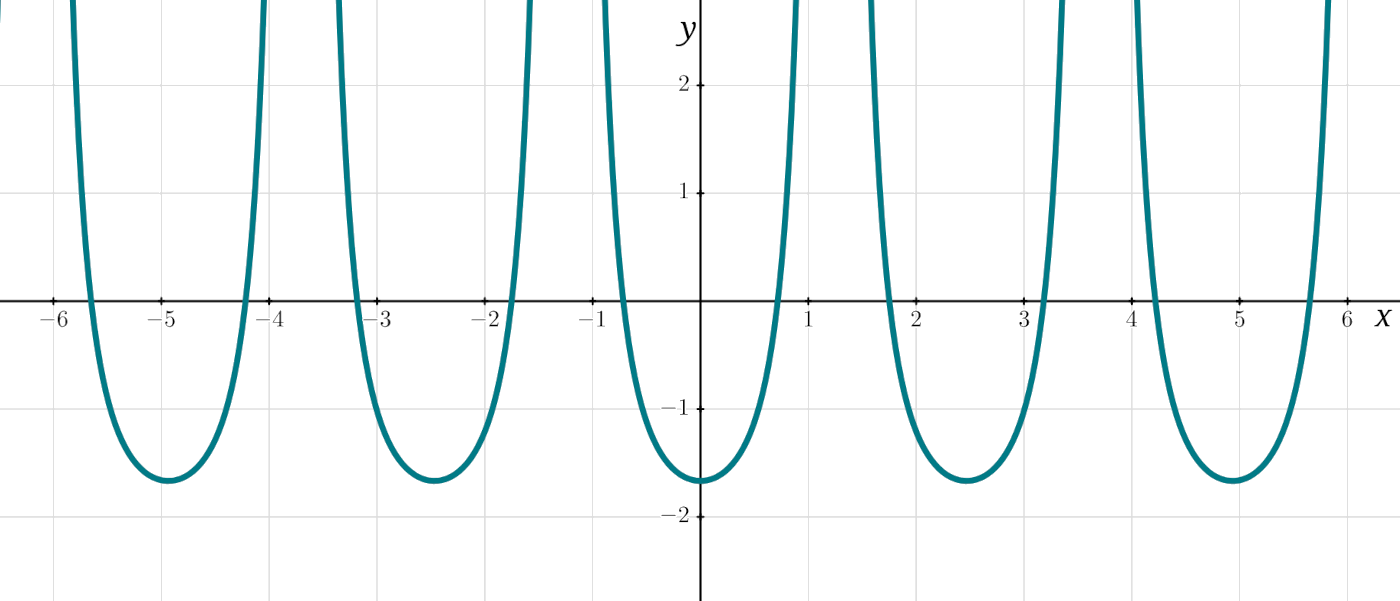
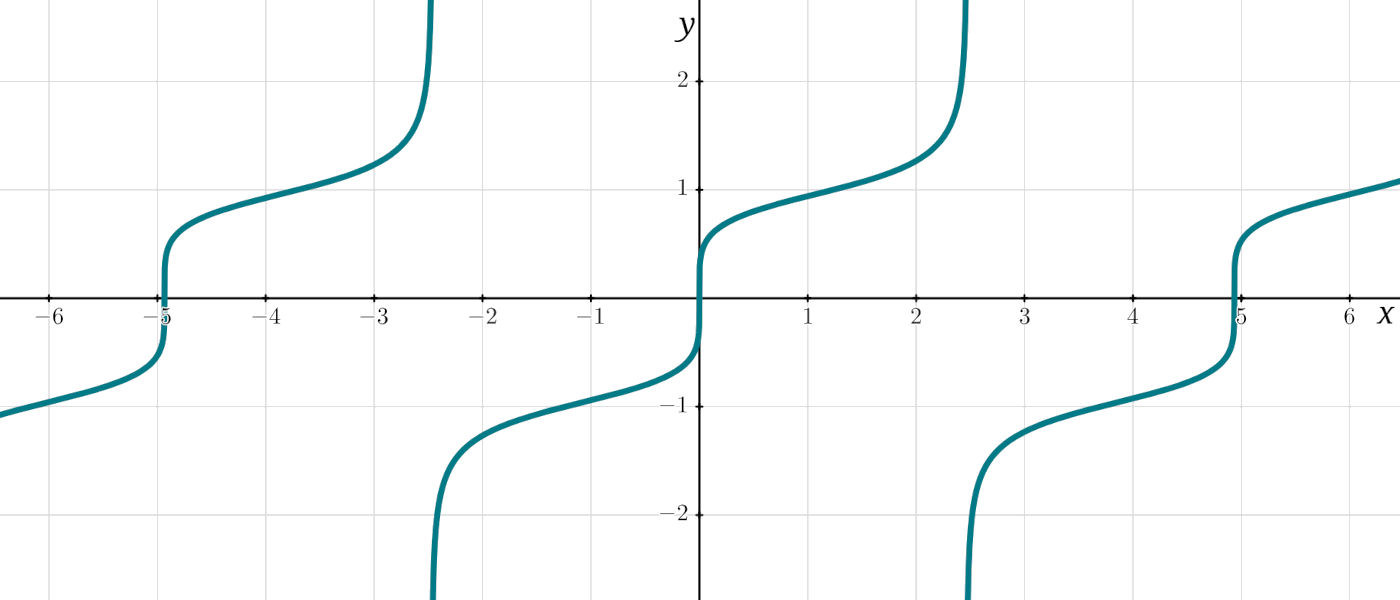
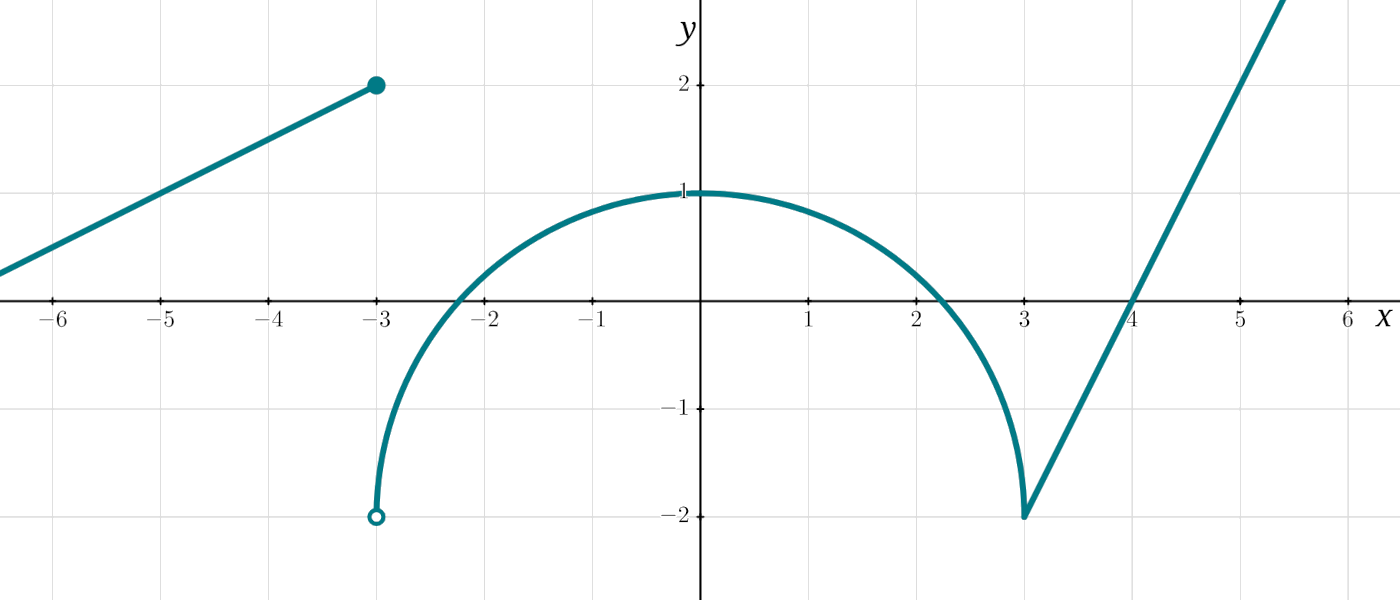
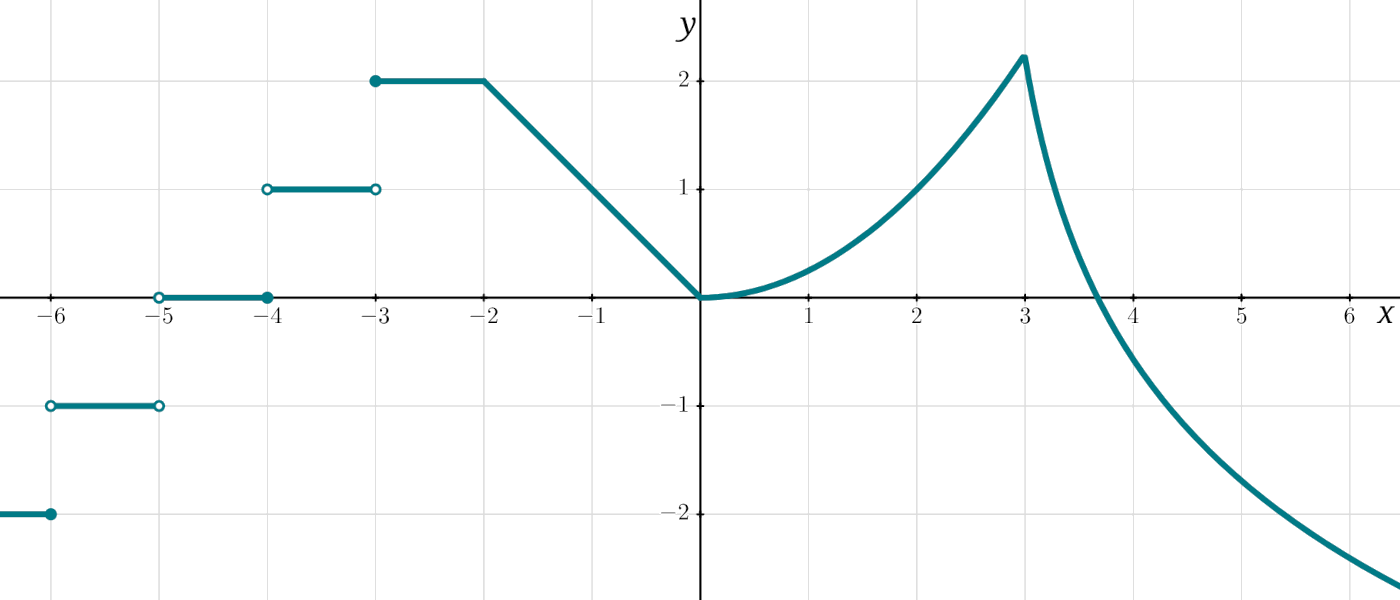
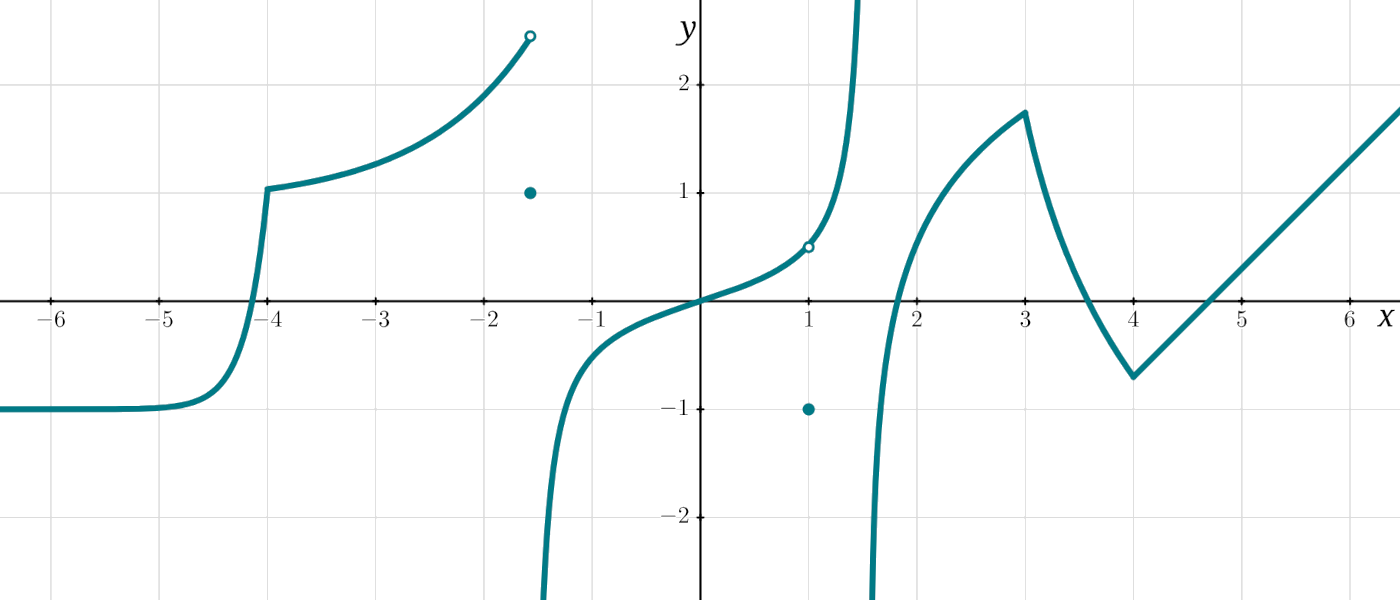
Sketch the graph of the derivative of each of the following functions graphed. It’s helpful to first note the inputs for which the derivative will be zero the inputs where the tangent line to the function’s graph is horizontal. Then between these points, note whether the function is increasing or decreasing and whether the function is concave or convex, and sketch the derivative accordingly. You can check your sketch’s accuracy by consulting with the instructor or a capable tutor.
-
For each of the following descriptions, sketch the graph of an example of such a function. First take stock of the input/output values involved in the description so you know how to scale your coordinate axes. Then before sketching the graph outright, make some notes on the plot, light annotations to guide you: mark points the graph must pass through or avoid, mark whether the graph is increasing/decreasing or concave up/down at a point, and mark the graph’s end-behavior. Cross out any part of the description you’ve accounted for. You can check your sketch’s accuracy by consulting with the instructor or a capable tutor.
- A continuous, differentiable function \(f\) such that \[ f(2) = 1 \qquad f'(2) = 0 \qquad f''(2) \gt 0 \qquad f(5) = 3 \qquad f'(5) = 0 \qquad f''(5) \lt 0 \,. \]
- A continuous, differentiable function \(f\) such that \[ \lim\limits_{x \to -\infty}f(x) = 1 \qquad f(0) = f'(0) = 1 \qquad f(2) = f'(2) = -2 \qquad \lim\limits_{x \to \infty}f(x) = -\infty \,. \]
- A continuous, differentiable function \(f\) such that \[ \lim\limits_{x \to -\infty}f(x) = 9 \qquad f(1) = -6 \quad f''(1) \lt 0 \quad f(3) = 0 \quad f'(3) \lt 0 \qquad f''(3) \gt 0\,. \]
- A continuous, differentiable function \(f\) such that \[ f(2) = 1 \qquad f(x) \lt 0 \text{ for } x \gt 3 \qquad f'(4) = 0 \qquad f''(4) \gt 0 \qquad \lim_{x \to \infty} f(x) = 0 \,. \]
- A continuous, differentiable function \(f\) such that \[ \lim\limits_{x \to -\infty}f(x) = \infty \quad f(0) = -1 \quad f'(0) = 1 \quad f''(0) \lt 0 \] \[ f'(4) = -2 \quad f(4) \lt f(5) \quad f'(5) = -\tfrac{1}{2} \quad \lim\limits_{x \to \infty}f(x) = 0 \]
- A function \(f\) that is continuous and differentiable everywhere except \(x = 2\) such that the limit approaching \(x = 2\) from either side exists, \[ \lim\limits_{x \to 2^-} f(x) \gt \lim\limits_{x \to 2^+} f(x) \] and \(f\) is concave up everywhere.
- A continuous function \(f\) for which \(f(1)=3\) and \(f(2)=1\) and \(f(3)=2,\) and \(f'(x) \neq 0\) for any \(x\) and \(f''(x) = 0\) for every \(x\) at which \(f''\) is defined.
- A continuous, differentiable function \(f\) that is strictly increasing, and is concave up everywhere except at \({x = 0,}\) at which \({f''(0) = 0.}\)
-
Manually sketch the graph of each of the following functions, taking stock of the function’s roots (\(x\)-intercepts), poles (asymptotes), end-behavior, local extrema, and inflection points by marking them accurately on the graph, labelling them with their coordinates. Once you’re confident in your sketch, plot the graph of the function using technology, e.g. a graphing calculator or Desmos, and compare it with your sketch.
\(\displaystyle a(x) = (x-1)(x-2)(x-5) \)\(\displaystyle b(x) = (x-1)^2(x-2)^3(x-5) \)\(\displaystyle c(x) = x\mathrm{e}^x \)\(\displaystyle d(x) = x^7-7x \)\(\displaystyle f(x) = \frac{x^2-5x+6}{x+1} \)\(\displaystyle g(x) = \frac{x-3}{x^2-x-2} \)\(\displaystyle h(x) = \frac{x-3}{x^2-x+1} \)\(\displaystyle i(x) = \frac{2^x}{x} \)\(\displaystyle j(x) = \ln(x)-x^2+5 \)\(\displaystyle k(x) = 1+\frac{1}{x}+\frac{1}{x^2}\)\(\displaystyle l(x) = \frac{x^2+7x}{49-x^2} \)\(\displaystyle m(x) = \frac{x^2}{x^2+7} \)\(\displaystyle n(x) = (x-7)\sqrt{x} \)\(\displaystyle o(x) = \frac{\sqrt[3]{x}}{x-1} \)\(\displaystyle p(x) = \sqrt{x^2-x+1} \)\(\displaystyle q(x) = x-\sqrt{x^2-x} \)\(\displaystyle r(x) = \frac{x^3}{x-2} \)\(\displaystyle s(x) = \frac{x}{\sqrt{x^2+7}} \)\(\displaystyle t(x) = 7\sqrt[3]{x}-x \)\(\displaystyle u(x) = \sqrt[3]{x^2-7} \)\(\displaystyle v(x) = x+2\cos(x) \)\(\displaystyle w(x) = \cos^3(x) \)\(\displaystyle z(x) = \sin(x)+\sqrt{3}\cos(x) \)