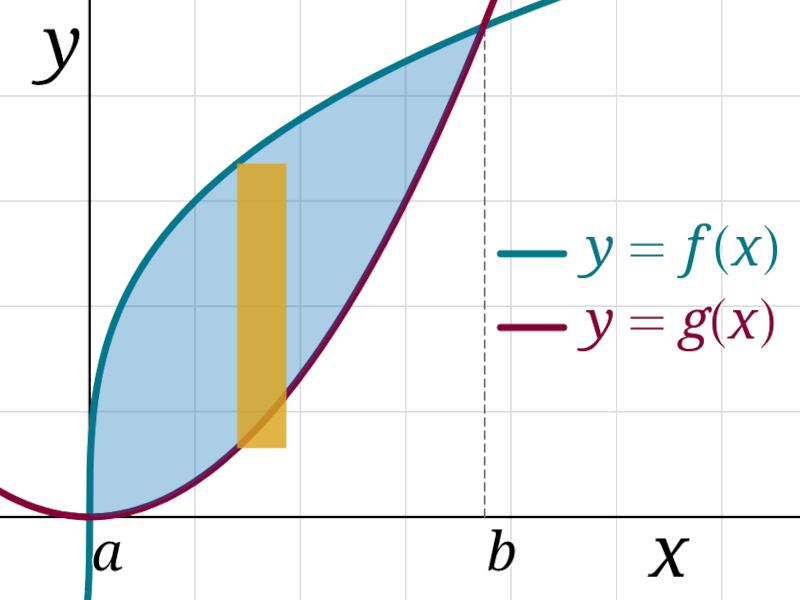
 Consider the region bound above by the graph \(y = f(x),\)
bound below by the graph \(y = g(x),\)
and bound on the left and right by \(x=a\) and \(x=b\) respectively.
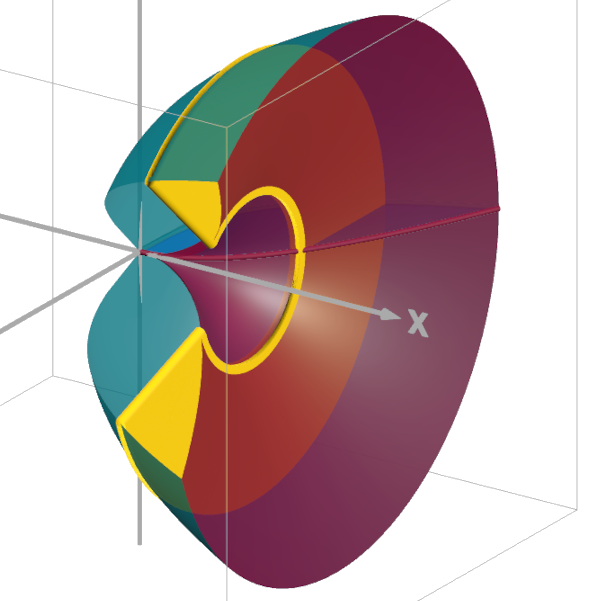
Imagine revolving this region about the \(x\)-axis,
tracing out a solid that is symmetric about the \(x\)-axis.
The volume of this solid is
\[ \int\limits_a^b \Bigl(\pi\bigl(f(x)\bigr)^2-\pi\bigl(g(x)\bigr)^2 \Bigr)\,\mathrm{d}x \]
which we read as adding up the volume accumulated from \(x=a\) to \(x=b\)
as we sum together the areas of the “washer”-shaped cross-sections
\(\pi\bigl(f(x)\bigr)^2\!-\!\pi\bigl(g(x)\bigr)^2\)
weighted by infinitesimal thickness \(\mathrm{d}x.\)
Consider the region bound above by the graph \(y = f(x),\)
bound below by the graph \(y = g(x),\)
and bound on the left and right by \(x=a\) and \(x=b\) respectively.
Imagine revolving this region about the \(x\)-axis,
tracing out a solid that is symmetric about the \(x\)-axis.
The volume of this solid is
\[ \int\limits_a^b \Bigl(\pi\bigl(f(x)\bigr)^2-\pi\bigl(g(x)\bigr)^2 \Bigr)\,\mathrm{d}x \]
which we read as adding up the volume accumulated from \(x=a\) to \(x=b\)
as we sum together the areas of the “washer”-shaped cross-sections
\(\pi\bigl(f(x)\bigr)^2\!-\!\pi\bigl(g(x)\bigr)^2\)
weighted by infinitesimal thickness \(\mathrm{d}x.\)
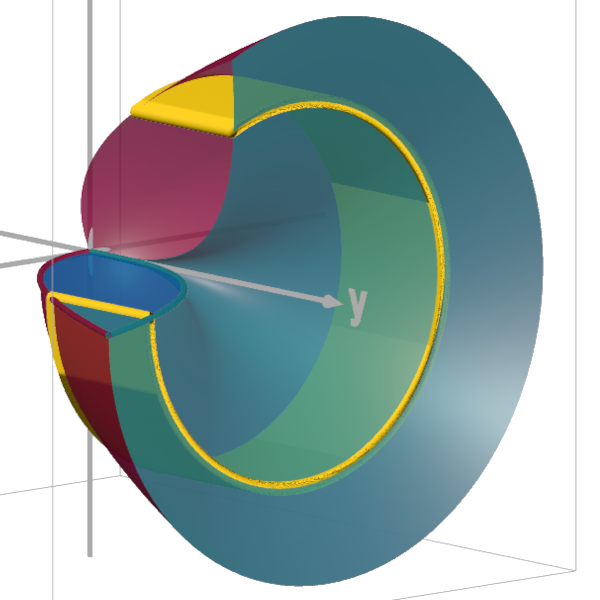 We can also compute the volume of a solid traced out by revolving a region about the \(y\)-axis.
The cross-sections in this case will be “shell”-shaped
with circumference \(2\pi x\) and height \(f(x)\!-\!g(x)\) and infinitesimal thickness \(\mathrm{d}x\)
The volume of this solid is
\[ \int\limits_a^b 2\pi x \Bigl(f(x)-g(x)\Bigr)\,\mathrm{d}x\,. \]
We can also compute the volume of a solid traced out by revolving a region about the \(y\)-axis.
The cross-sections in this case will be “shell”-shaped
with circumference \(2\pi x\) and height \(f(x)\!-\!g(x)\) and infinitesimal thickness \(\mathrm{d}x\)
The volume of this solid is
\[ \int\limits_a^b 2\pi x \Bigl(f(x)-g(x)\Bigr)\,\mathrm{d}x\,. \]