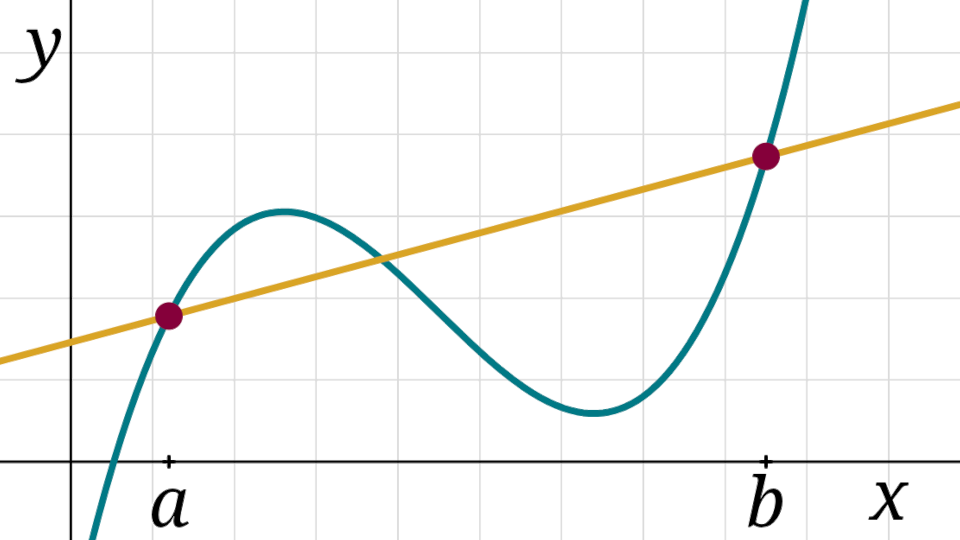
 The average rate-of-change of a continuous function \(f\)
between \(x=a\) and \(x=b\) is \[ \frac{f(b)-f(a)}{b-a}\,. \]
On the graph of \(f\) this is the slope of the line that passes through
the points \(\bigl(a, f(a)\bigr)\) and \(\bigl(b, f(b)\bigr).\)
This line is referred to as the secant line to the graph of \(f\) through these points.
The slope of this secant line and the average rate-of-change of \(f\)
are only equal if \(f\) is continuous between \(a\) and \(b.\)
The average rate-of-change of a continuous function \(f\)
between \(x=a\) and \(x=b\) is \[ \frac{f(b)-f(a)}{b-a}\,. \]
On the graph of \(f\) this is the slope of the line that passes through
the points \(\bigl(a, f(a)\bigr)\) and \(\bigl(b, f(b)\bigr).\)
This line is referred to as the secant line to the graph of \(f\) through these points.
The slope of this secant line and the average rate-of-change of \(f\)
are only equal if \(f\) is continuous between \(a\) and \(b.\)
 The instantaneous rate-of-change of a continuous function \(f\)
at \(x=c\) is the rate-of-change of \(f\) at a single moment,
and can be approximated by an average rates-of-change on a narrow interval containing \(c.\)
On the graph of \(f\) this is the slope of the line
that just barely touches the graph at the point \(\bigl(c, f(c)\bigr).\)
This line is referred to as the tangent line to the graph of \(f,\)
and \(\bigl(c, f(c)\bigr)\) is called the point of tangency.
The instantaneous rate-of-change of a continuous function \(f\)
at \(x=c\) is the rate-of-change of \(f\) at a single moment,
and can be approximated by an average rates-of-change on a narrow interval containing \(c.\)
On the graph of \(f\) this is the slope of the line
that just barely touches the graph at the point \(\bigl(c, f(c)\bigr).\)
This line is referred to as the tangent line to the graph of \(f,\)
and \(\bigl(c, f(c)\bigr)\) is called the point of tangency.
The line passing through \(\bigl(c, f(c)\bigr)\)
perpendicular to the tangent is called the normal line.
If \(x\) and \(f(x)\) have units, the units of the slope of a secant, tangent, or normal line will be the ratio of the units of \(f(x)\) and \(x.\)