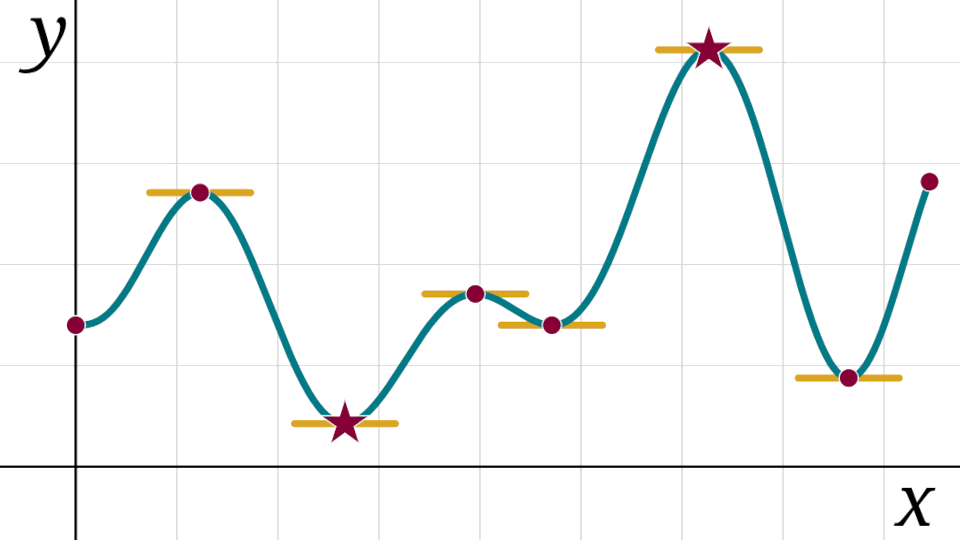
 Extreme Value Theorem –
If \(f\) is continuous on a closed interval \([a,b],\)
there must exist an absolute extremum of \(f\) on that interval.
Extreme Value Theorem –
If \(f\) is continuous on a closed interval \([a,b],\)
there must exist an absolute extremum of \(f\) on that interval.
The extrema of \(f\) can be found among
the values of \(f(c)\) at each of its critical points \(c\)
together with the values of \(f\) on its boundary,
i.e. the values at the endpoints \(f(a)\) and \(f(b).\)
An optimization problem statement has this standard template:
\[ \text{``Minimize/Maximize [}\mathit{function}\text{] subject to [}\mathit{constraints}\text{].''} \]
So to solve an optimization problem:
- Write down a formula for the \(\mathit{function}\) in question. The formula might contain more than one independent variable.
- Write down formulas for any \(\mathit{constraints}\) in question, and use those constraints to re-write the \(\mathit{function}\) as a single-variable function \(f.\)
- Determine the critical values of \(f.\)
- Evaluate \(f(c)\) for each of those critical values of \(c,\) and evaluate \(f\) on the boundary of its domain: \(f(a)\) and \(f(b)\) — among all of those output values, the largest will be the absolute maximum value of \(f\) and the smallest will be the absolute minimum value of \(f.\)