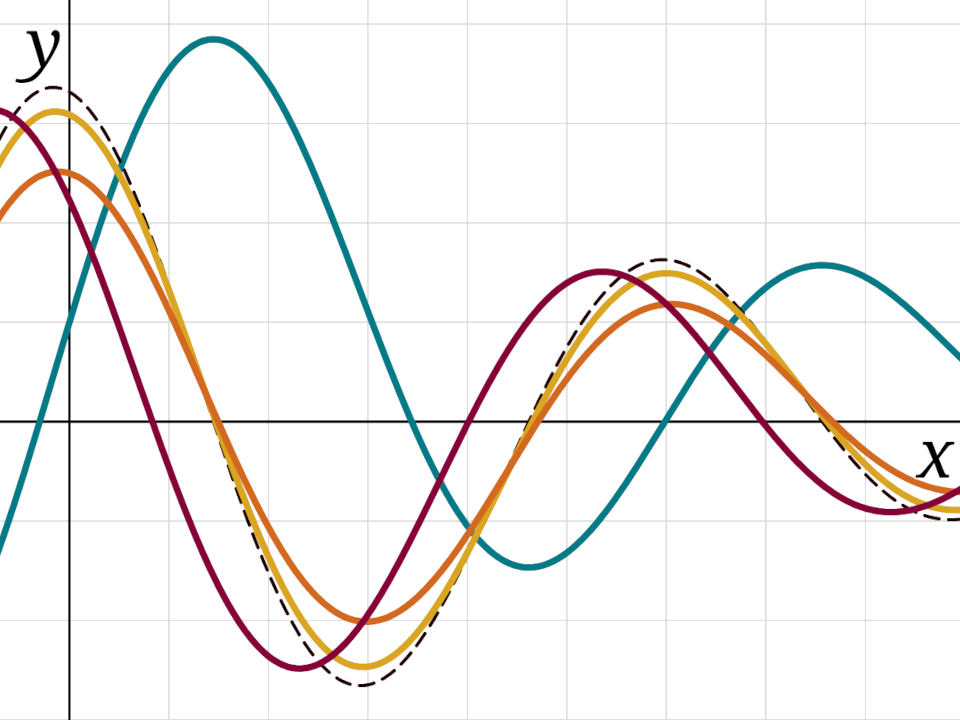
 Since the derivative is defined in terms of a limit,
just like a limit can be approximated numerically,
so too can a derivative.
\[\begin{align*}
f'(x) &= \lim\limits_{h \to 0} \frac{f(x+h)-f(x)}{h}
\\[1em]\qquad \implies \qquad
f'(x) &\approx \frac{f(x+h)-f(x)}{h}\text{ for a small value of } h
\end{align*} \]
This difference quotient is asymmetric,
weighted to the right of \(x.\)
A symmetric difference quotient
provides a better approximation \(f'(x):\)
\[ f'(x) \approx \frac{f(x+h)-f(x-h)}{2h}\text{ for a small value of } h \]
Since the derivative is defined in terms of a limit,
just like a limit can be approximated numerically,
so too can a derivative.
\[\begin{align*}
f'(x) &= \lim\limits_{h \to 0} \frac{f(x+h)-f(x)}{h}
\\[1em]\qquad \implies \qquad
f'(x) &\approx \frac{f(x+h)-f(x)}{h}\text{ for a small value of } h
\end{align*} \]
This difference quotient is asymmetric,
weighted to the right of \(x.\)
A symmetric difference quotient
provides a better approximation \(f'(x):\)
\[ f'(x) \approx \frac{f(x+h)-f(x-h)}{2h}\text{ for a small value of } h \]
Both of these approximations rely on only two points; using more point can provide a better approximation. For example, the points \[ \bigl(x\!-\!2h, f(x\!-\!2h)\bigr) \qquad \bigl(x\!-\!h, f(x\!-\!h)\bigr) \qquad \bigl(x, f(x)\bigr) \qquad \bigl(x\!+\!h, f(x\!+\!h)\bigr) \qquad \bigl(x\!+\!2h, f(x\!+\!2h)\bigr) \] are referred to as a five-point stencil of \(f\) around \(x,\) and advanced calculus techniques (Taylor’s Theorem) provide us the approximation \[ f'(x) \approx \frac{f(x-2h) - 8f(x-h) + 8f(x+h) - f(x+2h)}{12h}\text{ for a small value of } h\,. \]