The zeros (or roots) of a function \(f\) are all values of \(r\) in the domain of \(f\) for which \(f(r) = 0.\) Newton’s method is an algorithm for approximating the roots of a differentiable function to arbitrary precision. The big idea is that if \(c\) is close to a root of \(f,\) then the \(x\)-intercept of the line tangent to the graph of \(f\) at \(c\) will typically be even closer to the root than \(c.\)
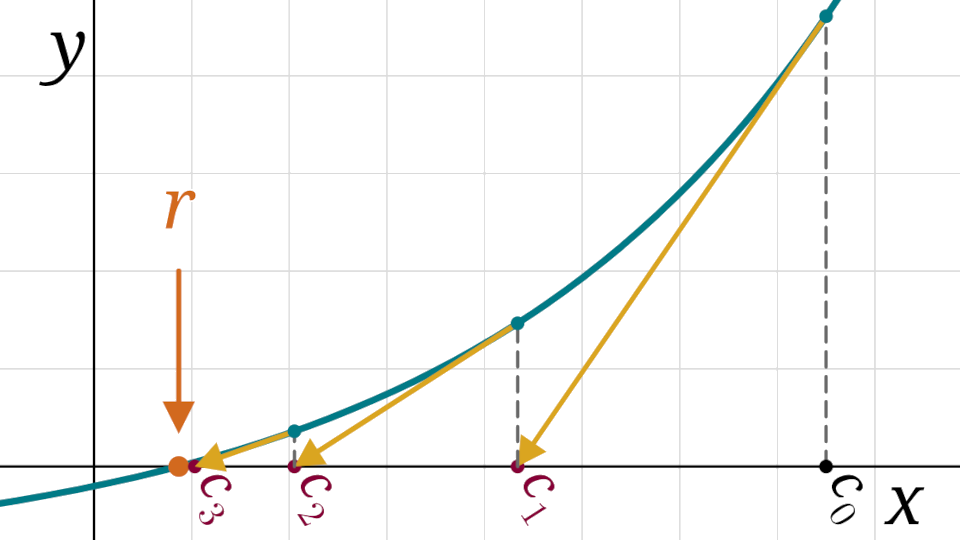 To be precise, suppose \(f\) is a differentiable function with root \(r.\)
Choose some \(c_0\) close to the root \(r\)
to serve as the seed to initiate Newton’s method.
The \(x\)-intercept of the line tangent to the graph of \(f\) at \(c_0\)
is the number \( c_0\!-\!\tfrac{f(c_0)}{f'(c_0)}\,.\)
Call that number \(c_1.\)
Then evaluate that formula again with \(c_1\) in place of \(c_0,\)
and then again with \(c_2\) in place of \(c_1,\)
and again with \(c_3\) in place of \(c_2,\) and so on:
for each number \(c_n\) iteratively compute the next number as
\[ c_{n+1} = c_n - \frac{f(c_n)}{f'(c_n)}\,. \]
This sequence of values \(\{c_0, c_1, c_2, c_3, \dotsc\}\)
will (typically) converge to the exact value of the root \(r.\)
To be precise, suppose \(f\) is a differentiable function with root \(r.\)
Choose some \(c_0\) close to the root \(r\)
to serve as the seed to initiate Newton’s method.
The \(x\)-intercept of the line tangent to the graph of \(f\) at \(c_0\)
is the number \( c_0\!-\!\tfrac{f(c_0)}{f'(c_0)}\,.\)
Call that number \(c_1.\)
Then evaluate that formula again with \(c_1\) in place of \(c_0,\)
and then again with \(c_2\) in place of \(c_1,\)
and again with \(c_3\) in place of \(c_2,\) and so on:
for each number \(c_n\) iteratively compute the next number as
\[ c_{n+1} = c_n - \frac{f(c_n)}{f'(c_n)}\,. \]
This sequence of values \(\{c_0, c_1, c_2, c_3, \dotsc\}\)
will (typically) converge to the exact value of the root \(r.\)
Newton’s method only typically converges though. There are examples of differentiable functions \(f\) with root \(r\) for which certain choices of initial seed \(c_0\) will “blow up” to either \(\infty\) or \(-\infty,\) diverging instead of converging.