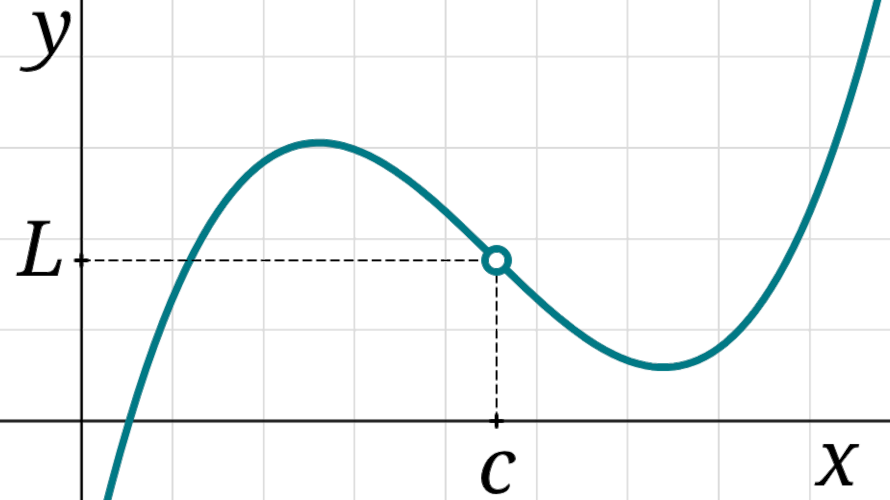
 The notation \( \lim_{x \to c^-} f(x) \) is read as
“the limit of \(f(x)\) as \(x\) approaches \(c\) from the left,”
and denotes the number that the output value \(f(x)\) get closer and closer to
as the input value \(x\) approaches \(c\) from the negative direction (if that number exists!).
Similarly \( \lim_{x \to c^+} f(x) \) is read as
“the limit of \(f(x)\) as \(x\) approaches \(c\) from the right,”
and denotes the number that the output value \(f(x)\) get closer and closer to
as the input value \(x\) approaches \(c\) from the positive direction.
If both of these one-sided limits exist and are the same number \(L,\)
then we drop the superscript \(+/-\) and simply write
\[ L = \lim\limits_{x \to c} f(x)\,. \]
The notation \( \lim_{x \to c^-} f(x) \) is read as
“the limit of \(f(x)\) as \(x\) approaches \(c\) from the left,”
and denotes the number that the output value \(f(x)\) get closer and closer to
as the input value \(x\) approaches \(c\) from the negative direction (if that number exists!).
Similarly \( \lim_{x \to c^+} f(x) \) is read as
“the limit of \(f(x)\) as \(x\) approaches \(c\) from the right,”
and denotes the number that the output value \(f(x)\) get closer and closer to
as the input value \(x\) approaches \(c\) from the positive direction.
If both of these one-sided limits exist and are the same number \(L,\)
then we drop the superscript \(+/-\) and simply write
\[ L = \lim\limits_{x \to c} f(x)\,. \]
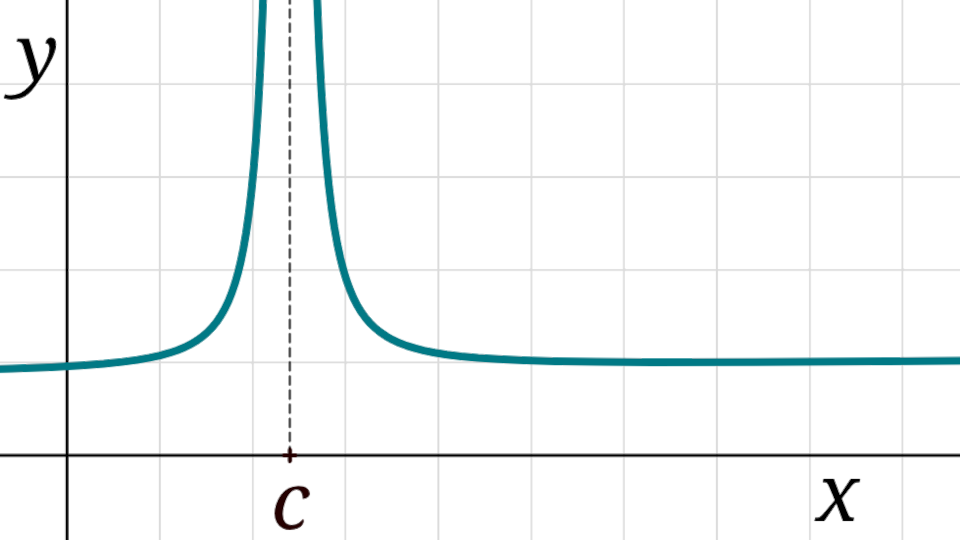
If \(f\) has a pole at \(c,\) then the graph of \(f\) will have a vertical asymptote of \(x=c.\) In this case, while technically \(\lim_{x \to c} f(x)\) doesn’t exist, we often abuse this limit notation and write \(\lim_{x \to c} f(x) = \infty\) or \(\lim_{x \to c} f(x) = -\infty\) if \(f\) behaves uniformly around the pole.
 This limit notation is often also overloaded to describe the end behavior of a function too.
The limit \(\lim_{x \to \infty} f(x)\) denotes the number
that the output value \(f(x)\) approaches as \(x\) increases to \(\infty,\) if that number exists.
Similarly \(\lim_{x \to -\infty} f(x)\) denotes the number
that the output value \(f(x)\) approaches as \(x\) decreases to \(-\infty.\)
These limits only exist if the graph of \(f\)
has a horizontal asymptote on the corresponding side,
eventually “levelling-out” on the right or left.
This limit notation is often also overloaded to describe the end behavior of a function too.
The limit \(\lim_{x \to \infty} f(x)\) denotes the number
that the output value \(f(x)\) approaches as \(x\) increases to \(\infty,\) if that number exists.
Similarly \(\lim_{x \to -\infty} f(x)\) denotes the number
that the output value \(f(x)\) approaches as \(x\) decreases to \(-\infty.\)
These limits only exist if the graph of \(f\)
has a horizontal asymptote on the corresponding side,
eventually “levelling-out” on the right or left.