Constants factor out of limits; limits break up across sum and differences and products and quotients; the limit of a power of a function is that power of the limit of the function. Expressing these “laws” in limit notation: \[ \lim\limits_{x \to c} \Bigl( k f(x) \Bigr) = k \lim\limits_{x \to c} f(x) \qquad \qquad \lim\limits_{x \to c} \Bigl( f(x) \pm g(x) \Bigr) = \lim\limits_{x \to c} f(x) \pm \lim\limits_{x \to c} g(x) \qquad \qquad \lim\limits_{x \to c} \Bigl( f(x) g(x) \Bigr) = \Bigl(\lim\limits_{x \to c} f(x) \Bigr)\Bigl( \lim\limits_{x \to c} g(x) \Bigr) \] \[ \lim\limits_{x \to c} \biggl( \frac{f(x)}{g(x)} \biggr) = \frac{\lim\limits_{x \to c} f(x)}{\lim\limits_{x \to c} g(x)} \quad{\color{gray}\text{ provided } \lim\limits_{x \to c} g(x) \neq 0} \qquad \qquad \lim\limits_{x \to c} \bigl( f(x) \bigr)^r = \Bigl( \lim\limits_{x \to c} f(x) \Bigr)^r \]
Furthermore, if \(f\) is a polynomial function, or any other continuous function, then \(\lim_{x \to c} f(x) = f(c)\) for any \(c.\)
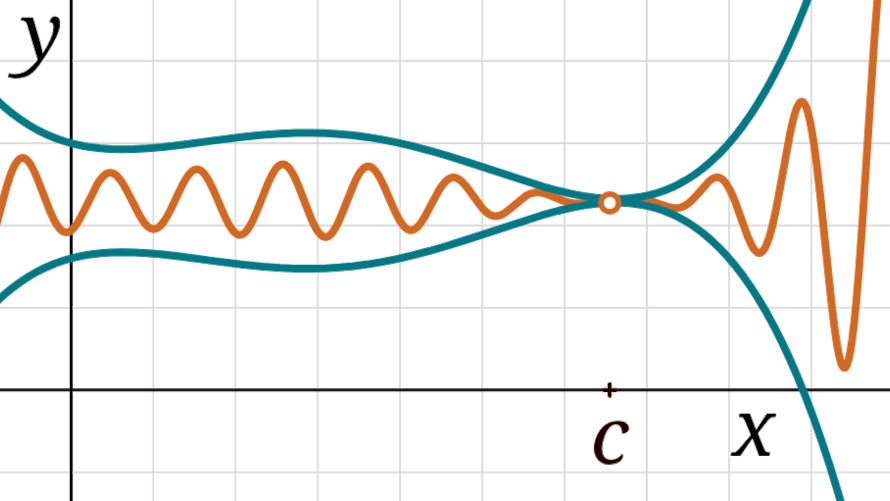 The Squeeze Theorem –
Suppose that \(\lim_{x \to c} f(x) = L\) and \(\lim_{x \to c} g(x) = L.\)
If the function \(s\) squeezes between \(f\) and \(g\) around \(c,\)
which is to say \({f(x) \leq s(x) \leq g(x)}\) for all \(x\) in some interval containing \(c,\)
then \({\lim_{x \to c} s(x) = L}\) too.
The Squeeze Theorem –
Suppose that \(\lim_{x \to c} f(x) = L\) and \(\lim_{x \to c} g(x) = L.\)
If the function \(s\) squeezes between \(f\) and \(g\) around \(c,\)
which is to say \({f(x) \leq s(x) \leq g(x)}\) for all \(x\) in some interval containing \(c,\)
then \({\lim_{x \to c} s(x) = L}\) too.