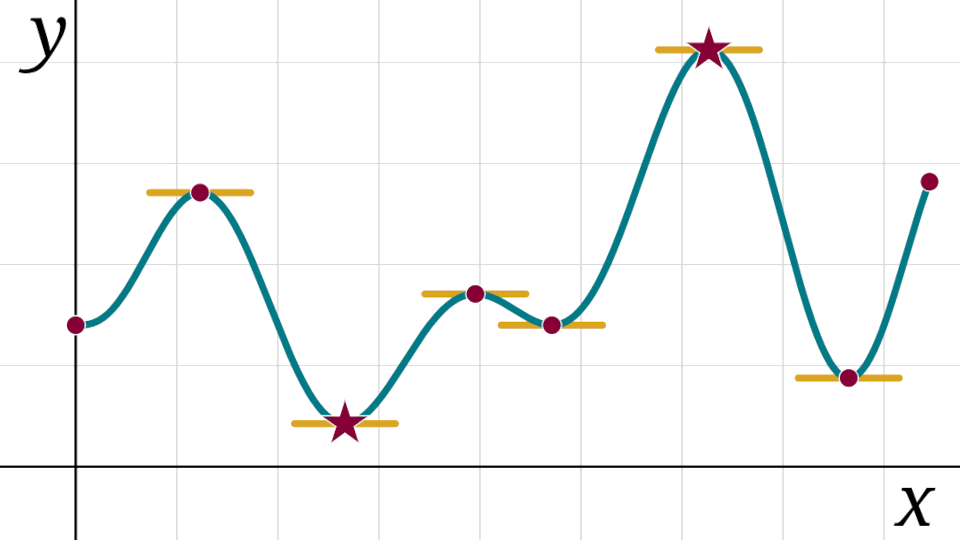
 A function \(f\) has a relative (local) minimum at \(x = c\)
if \({f(c) \leq f(x)}\) for all \(x\) in an interval around \(c;\)
the number \(f(c)\) is the value of that relative (local) minimum.
If \({f(c) \leq f(x)}\) for all \(x\) in the domain of \(f,\)
the number \(f(c)\) is called the absolute (global) minimum.
Relative and absolute maximum values are defined similarly,
and a minimum or maximum value is generally referred to
as an extremum (pl. extrema).
A function \(f\) has a relative (local) minimum at \(x = c\)
if \({f(c) \leq f(x)}\) for all \(x\) in an interval around \(c;\)
the number \(f(c)\) is the value of that relative (local) minimum.
If \({f(c) \leq f(x)}\) for all \(x\) in the domain of \(f,\)
the number \(f(c)\) is called the absolute (global) minimum.
Relative and absolute maximum values are defined similarly,
and a minimum or maximum value is generally referred to
as an extremum (pl. extrema).
Fermat’s Theorem –
If \(f\) has an extremum at \(x=c\)
and \(f'(c)\) exists, then \(f'(c)=0.\)
Such a number \(c\) in the domain of \(f\)
at which either \(f'(c) = 0\) or \(f'(c)\) doesn’t exist
is called a critical number,
and the point \(\bigl(c, f(c)\bigr)\) on the graph of \(f\)
is the critical point corresponding to \(c.\)
A function’s collection of critical points serves as a list
of all possible candidates for locations of the function’s extrema.
Extreme Value Theorem – If \(f\) is continuous on a closed interval \([a,b],\) there must exist an absolute extremum of \(f\) on that interval.
Rolle’s Theorem – If \(f\) is continuous on \([a,b]\) and differentiable on \((a,b),\) and \(f(a) = f(b),\) there must exist \(c\) in \((a,b)\) such that \(f'(c)=0.\)
Mean Value Theorem – If \(f\) is continuous on \([a,b]\) and differentiable on \((a,b),\) there must exist \(c\) in \((a,b)\) such that \( \displaystyle f'(c) = \frac{f(b)-f(a)}{b-a}\,.\)