While algebra is the studying of how changing quantities can be expressed with variables and equations, and how those variables can be pushed around within those equations, the equations themselves are quite static: an equation represents only a single slice of time. In contrast, calculus is the study of the mathematical tools to symbolically represent the change in a quantity itself, affording us dynamic variables in our equations. There’ve been whispers of the ideas of calculus among mathematicians for thousands of years, but it was in the 1600s that the core concepts of calculus as were know them today were first introduced to answer questions like these:
- Given the position of an object at any moment of time, can we calculate that object’s speed at any moment too?
- Given the speed and direction of an object’s trajectory at any moment of time, can we determine its position at any moment?
- Kepler’s laws of planetary motion: (1) the orbit of a planet around the sun traces out an ellipse, the sun located at a focus of the ellipse, (2) as it orbits, the line segment between a planet and the sun sweeps out equal areas during equal intervals of time, and (3) the square of a planet's orbital period is proportional to the cube of the length of the semimajor axis of its orbit. But Kepler noticed these facts empirically, making observations and analysing data. Why are these facts true?
-
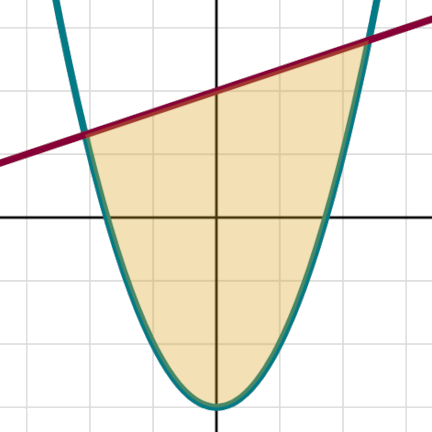
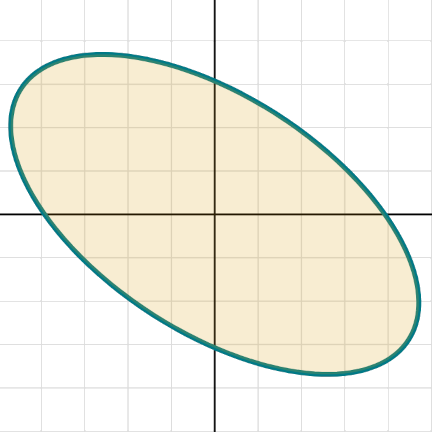 We know how to calculate the area of simple, straight-sided shapes like rectangles and triangles,
but what about shapes with curved boundaries?
Like, what’s the area inside a portion of a parabola?
What’s the area of an ellipse?
How do we know the area of a circle is \(\pi r^2\)?
We know how to calculate the area of simple, straight-sided shapes like rectangles and triangles,
but what about shapes with curved boundaries?
Like, what’s the area inside a portion of a parabola?
What’s the area of an ellipse?
How do we know the area of a circle is \(\pi r^2\)?