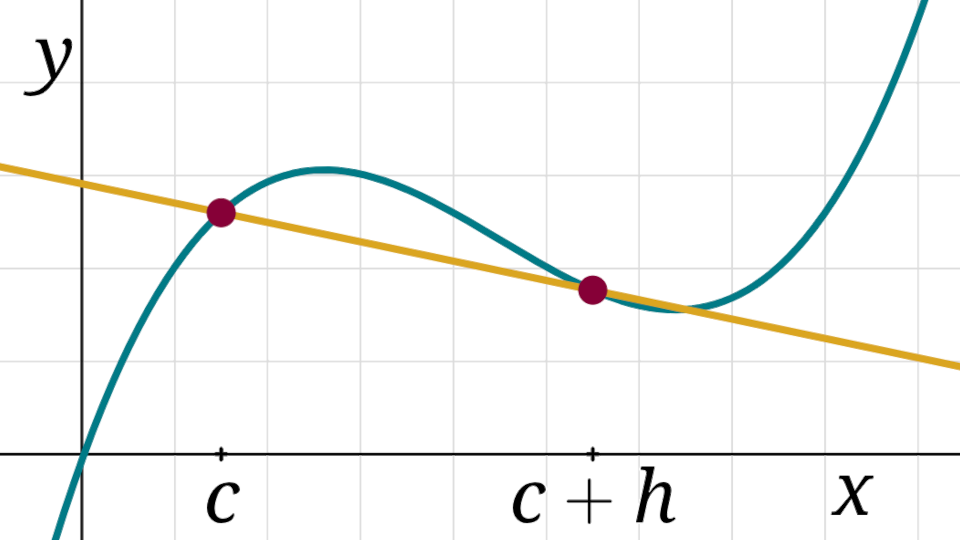
 The average rate-of-change of a continuous function \(f\)
on an interval of length \(h\) after (to the right of) a point \(x=c\) is
\[ \frac{f(c+h)-f(c)}{h}\,. \]
This expression is called a difference quotient of \(f\) at \(c.\)
On the graph of \(f\) this is the slope of the secant line that passes through
the points \(\bigl(c, f(c)\bigr)\) and \(\bigl(c+h, f(c+h)\bigr).\)
The average rate-of-change of a continuous function \(f\)
on an interval of length \(h\) after (to the right of) a point \(x=c\) is
\[ \frac{f(c+h)-f(c)}{h}\,. \]
This expression is called a difference quotient of \(f\) at \(c.\)
On the graph of \(f\) this is the slope of the secant line that passes through
the points \(\bigl(c, f(c)\bigr)\) and \(\bigl(c+h, f(c+h)\bigr).\)
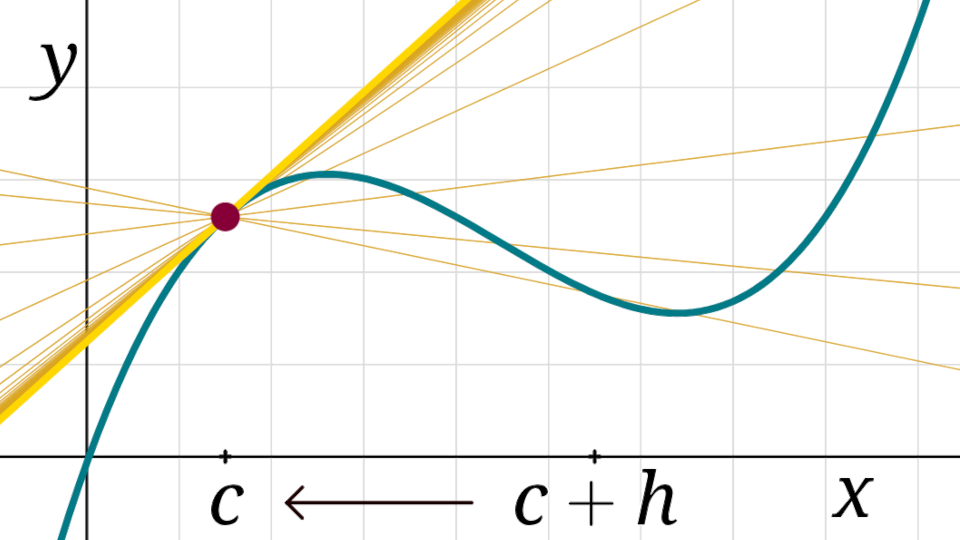 The instantaneous rate-of-change of a continuous function \(f\)
at a point \(x=c\) is \[ \lim\limits_{h\to 0}\frac{f(c+h)-f(c)}{h}\,. \]
On the graph of \(f\) this is the slope of the tangent line at \(\bigl(c, f(c)\bigr).\)
The function \(f\) must be continuous around \(c\) for this limit to exist.
When this limits exists we say \(f\) is differentiable at \(x=c,\)
we refer to the value of this limit as the derivative of \(f\) at \(x=c,\)
and we denote the value of this limit, the slope of the tangent line,
as \(f'(c)\) (which we read as “\(f\) prime at \(c\)”).
The instantaneous rate-of-change of a continuous function \(f\)
at a point \(x=c\) is \[ \lim\limits_{h\to 0}\frac{f(c+h)-f(c)}{h}\,. \]
On the graph of \(f\) this is the slope of the tangent line at \(\bigl(c, f(c)\bigr).\)
The function \(f\) must be continuous around \(c\) for this limit to exist.
When this limits exists we say \(f\) is differentiable at \(x=c,\)
we refer to the value of this limit as the derivative of \(f\) at \(x=c,\)
and we denote the value of this limit, the slope of the tangent line,
as \(f'(c)\) (which we read as “\(f\) prime at \(c\)”).