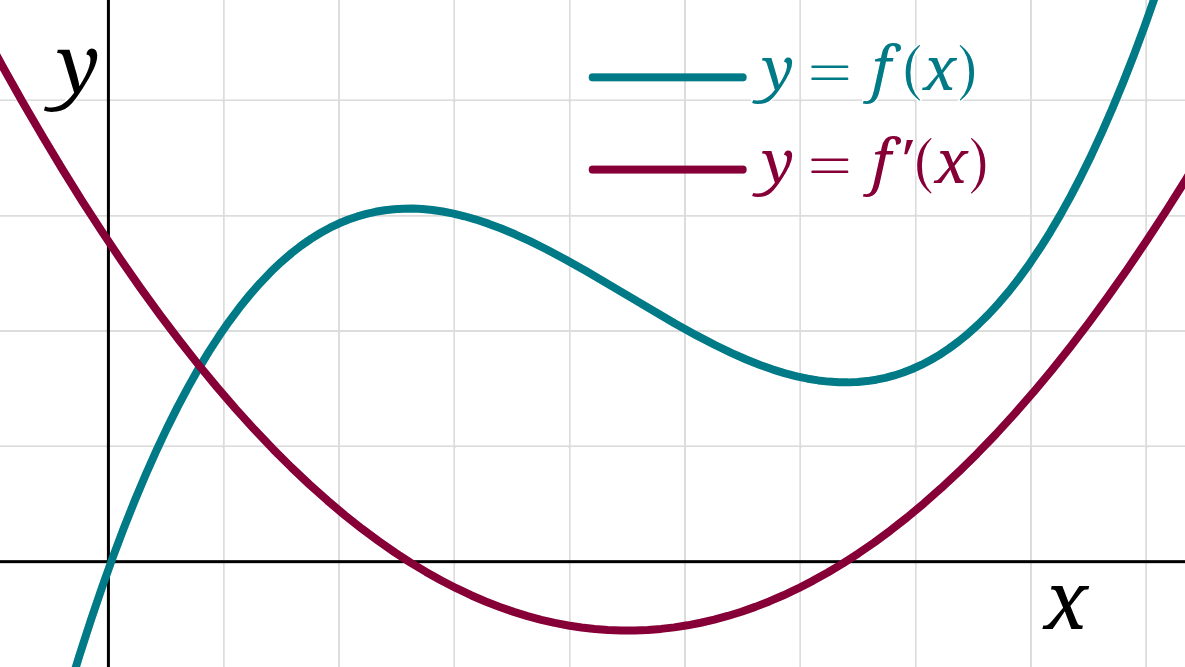
 Rather than describing the instantaneous rate-of-change of \(f\) at some specific point \(x=c,\)
let’s just keep \(x\) generic and define the derivative as a function of \(x.\)
The derivative of \(f\) with respect to \(x\) is the function \(f'\) defined as
\[ f'(x) = \lim\limits_{h \to 0}\frac{f(x+h)-f(x)}{h}\,. \]
There are a few common notations for the derivative function:
\[
f'
\qquad\qquad
\dot{y}
\qquad\qquad
\frac{\mathrm{d}}{\mathrm{d}x}\bigl(f\bigr)
\qquad\qquad
\frac{\mathrm{d}f}{\mathrm{d}x}
\qquad\qquad
\frac{\mathrm{d}y}{\mathrm{d}x}
\qquad\qquad
\operatorname{D}(f)
\qquad\qquad
f_x
% \qquad\qquad
% f_1
\]
The \(\frac{\mathrm{d}f}{\mathrm{d}x}\) notation
alludes to the derivative being a slope.
The \(\mathrm{d}\) in that notation
may be read as “a small deviation in,”
and so \(\frac{\mathrm{d}f}{\mathrm{d}x}\) is
“a small deviation in the output of \(f\)
per a small deviation in the input.”
The derivative is more specifically referred to as
the first-order derivative of \(f;\)
we may take further derivatives.
The second-order derivative of \(f,\)
the derivative of the derivative which represents
an instantaneous rate-of-change-of-the-rate-of-change of \(f,\)
is commonly denoted as:
\[
f''
\qquad\qquad
(f')'
\qquad\qquad
\ddot{y}
\qquad\qquad
\frac{\mathrm{d}}{\mathrm{d}x} \biggl( \frac{\mathrm{d}}{\mathrm{d}x} \bigl( f \bigr) \biggr)
\qquad\qquad
\frac{\mathrm{d^2}}{\mathrm{d}x^2} \bigl( f \bigr)
\qquad\qquad
\frac{\mathrm{d^2}f}{\mathrm{d}x^2}
\qquad\qquad
\frac{\mathrm{d^2}y}{\mathrm{d}x^2}
\qquad\qquad
\operatorname{D}^2(f)
\qquad\qquad
f_{xx}
% \qquad\qquad
% f_{1\,1}
\]
E.g. if \(f\) represents a position,
then \(f'\) represents a velocity,
and \(f''\) represents the rate-of-change of that velocity, an acceleration.
Rather than describing the instantaneous rate-of-change of \(f\) at some specific point \(x=c,\)
let’s just keep \(x\) generic and define the derivative as a function of \(x.\)
The derivative of \(f\) with respect to \(x\) is the function \(f'\) defined as
\[ f'(x) = \lim\limits_{h \to 0}\frac{f(x+h)-f(x)}{h}\,. \]
There are a few common notations for the derivative function:
\[
f'
\qquad\qquad
\dot{y}
\qquad\qquad
\frac{\mathrm{d}}{\mathrm{d}x}\bigl(f\bigr)
\qquad\qquad
\frac{\mathrm{d}f}{\mathrm{d}x}
\qquad\qquad
\frac{\mathrm{d}y}{\mathrm{d}x}
\qquad\qquad
\operatorname{D}(f)
\qquad\qquad
f_x
% \qquad\qquad
% f_1
\]
The \(\frac{\mathrm{d}f}{\mathrm{d}x}\) notation
alludes to the derivative being a slope.
The \(\mathrm{d}\) in that notation
may be read as “a small deviation in,”
and so \(\frac{\mathrm{d}f}{\mathrm{d}x}\) is
“a small deviation in the output of \(f\)
per a small deviation in the input.”
The derivative is more specifically referred to as
the first-order derivative of \(f;\)
we may take further derivatives.
The second-order derivative of \(f,\)
the derivative of the derivative which represents
an instantaneous rate-of-change-of-the-rate-of-change of \(f,\)
is commonly denoted as:
\[
f''
\qquad\qquad
(f')'
\qquad\qquad
\ddot{y}
\qquad\qquad
\frac{\mathrm{d}}{\mathrm{d}x} \biggl( \frac{\mathrm{d}}{\mathrm{d}x} \bigl( f \bigr) \biggr)
\qquad\qquad
\frac{\mathrm{d^2}}{\mathrm{d}x^2} \bigl( f \bigr)
\qquad\qquad
\frac{\mathrm{d^2}f}{\mathrm{d}x^2}
\qquad\qquad
\frac{\mathrm{d^2}y}{\mathrm{d}x^2}
\qquad\qquad
\operatorname{D}^2(f)
\qquad\qquad
f_{xx}
% \qquad\qquad
% f_{1\,1}
\]
E.g. if \(f\) represents a position,
then \(f'\) represents a velocity,
and \(f''\) represents the rate-of-change of that velocity, an acceleration.