If \( \lim_{x \to c} f(x) = f(c), \) we say that \(f\) is continuous at \(c\). If \(f\) is continuous at every point in some interval then we say that \(f\) is continuous on the interval. If \(f\) is continuous at every point in its domain, then we say simply that \(f\) is continuous.
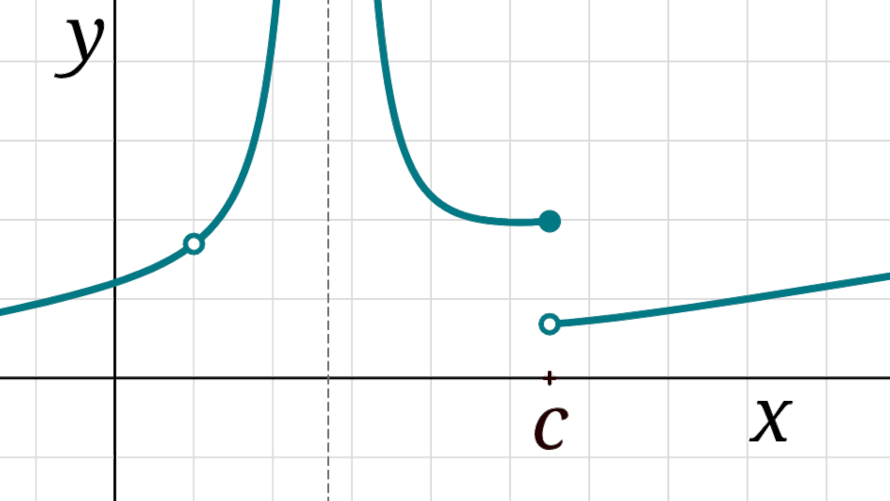 A value of \(c\) at which \(f\) is not continuous is called a discontinuity.
A function \(f\) has a removable discontinuity at \(c\)
if \(\lim_{x \to c} f(x)\) exists but \(f(c)\) is not defined;
when \(f\) is defined by a formula,
a removable discontinuity is usually due to some artifact in the formula that can be removed algebraically.
A value of \(c\) at which \(f\) is not continuous is called a discontinuity.
A function \(f\) has a removable discontinuity at \(c\)
if \(\lim_{x \to c} f(x)\) exists but \(f(c)\) is not defined;
when \(f\) is defined by a formula,
a removable discontinuity is usually due to some artifact in the formula that can be removed algebraically.
A function \(f\) has a jump discontinuity at \(c\)
if the one-sided limits \({\lim_{x \to c^-} f(x)}\) and \({\lim_{x \to c^+} f(x)}\)
both exist, but have different values.
A function \(f\) has an essential (infinite) discontinuity at \(c\)
if either \(\lim_{x \to c^-} f(x) = \pm \infty\) or \(\lim_{x \to c^+} f(x) = \pm \infty,\)
whereat the graph of \(f\) has a vertical asymptote.
The Intermediate Value Theorem – If \(f\) is continuous on the closed interval \([a,b]\) for which \(f(a) \neq f(b),\) and \(N\) is some number between \(f(a)\) and \(f(b),\) then there must exist some \(c\) between \(a\) and \(b\) such that \(f(c) = N.\)
Brouwer’s Fixed-Point Theorem – If \(f\) is continuous from the closed interval \([a,b]\) to itself, then \(f\) must have a fixed point, some number \(c\) between \(a\) and \(b\) such that \(f(c) = c.\)