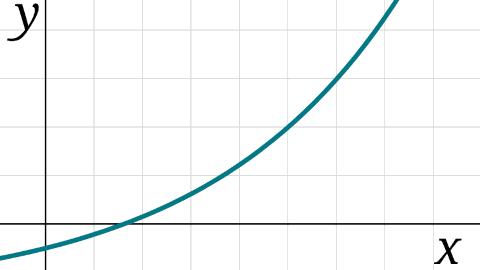
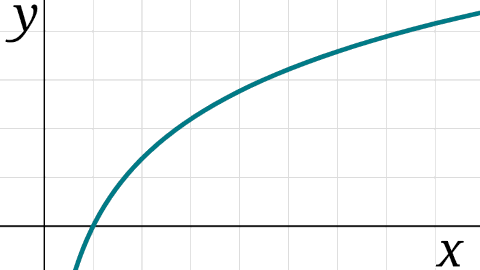
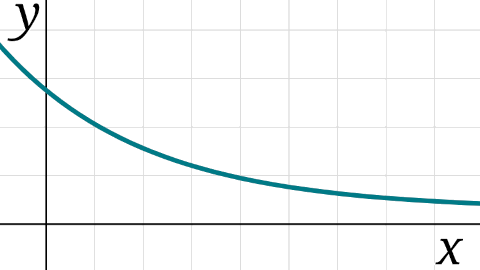
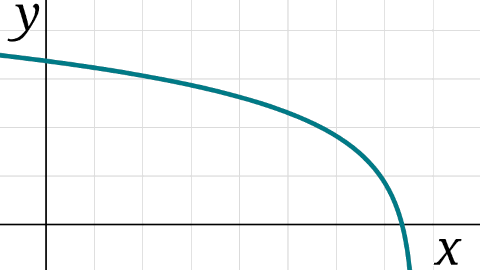
The sign (\(\pm\)) of \(f'(x)\) indicates whether the function \(f\) is increasing or decreasing at \(x.\) Supposing \(f\) has a local extremum at \(x=c,\) if \(f'(c) \lt 0\) to the left of \(c\) but \(f'(c) \gt 0\) to the right of \(c,\) then the extremum must be a local minimum, and vice-versa for a local maximum; this analysis is typically referred to as the first-derivative test. The sign of \(f''(x)\) however indicates whether the function \(f\) is accelerating or decelerating at \(x,\) whether the graph is “pulling upwards” or “pulling downwards”. The graph of \(f\) is concave up (or convex) on any interval for which \(f''(x) \gt 0\) and the graph of \(f\) is concave down (or just concave) on any interval for which \(f''(x) \lt 0.\)
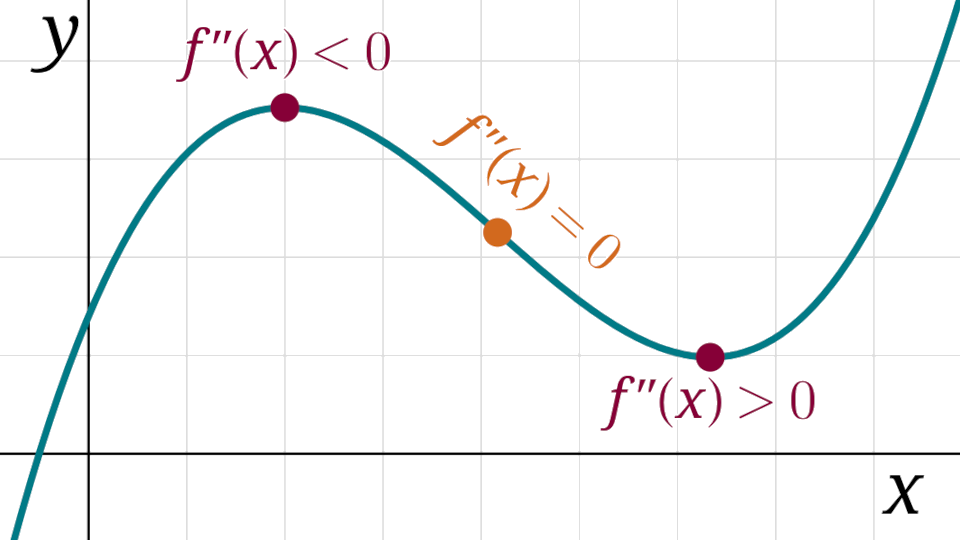 Supposing \(f\) has a local extremum at \(x=c,\)
if \(f''(c) \lt 0\) then the extremum must be a local maximum,
and if \(f''(c) \gt 0\) then the extremum must be a local minimum;
this analysis is typically referred to as the
second-derivative test.
Supposing \(f\) has a local extremum at \(x=c,\)
if \(f''(c) \lt 0\) then the extremum must be a local maximum,
and if \(f''(c) \gt 0\) then the extremum must be a local minimum;
this analysis is typically referred to as the
second-derivative test.
If a function \(f\) is continuous at \(x=c\) and switches concavity at \(x=c,\)
we call \(\bigl(c, f(c)\bigr)\) an inflection point of \(f.\)
If \(f\) has an inflection point at \(x=c\)
and \(f''(c)\) exists, then \(f''(c)=0.\)