Recap: for a single-variable function \(f\) with graph \(y = f(x)\) defined on the interval \(I = (a,b)\) within its domain, the definite integral of \(f\) over this interval, denoted \(\int_I f(x) \,\mathrm{d}x,\) is the area of the region bound vertically between the graph of \(f\) and the \(x\)-axis and bound on its sides between the lines \(x=a\) and \(x=b\) at the boundary of the interval.
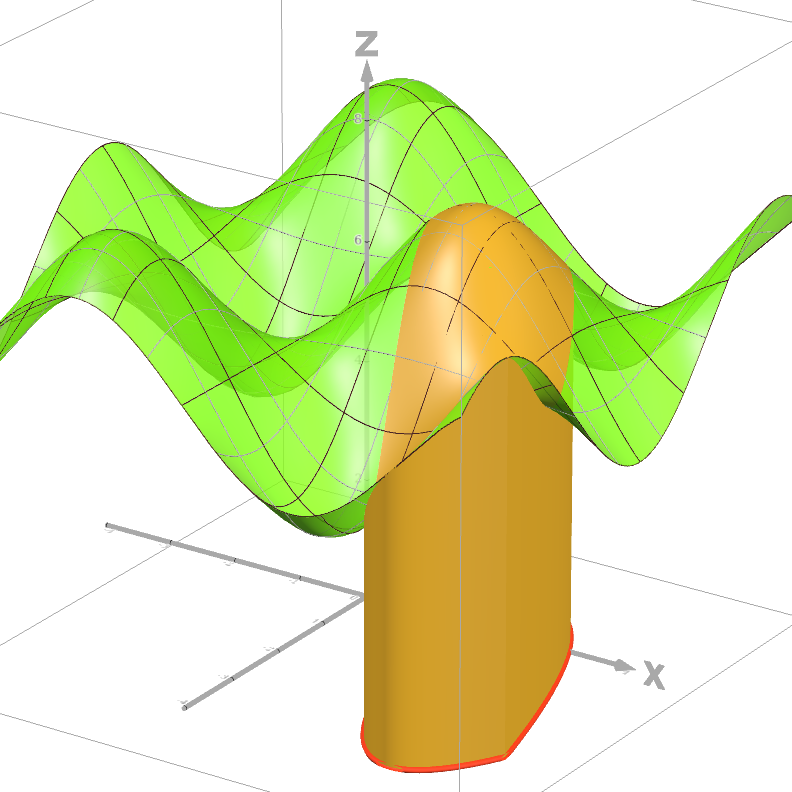 For a multivariable function \(f\) with graph \(z = f(x,y)\)
defined on the region \(R\) within its domain,
the definite integral of \(f\) over this region,
denoted as the double integral \[\iint_R f(x,y) \,\mathrm{d}A,\]
is the volume of the solid
bound vertically between the graph of \(f\) and the \(xy\)-plane
and bound around its sides by the boundary of the region \(R.\)
The differential \(\mathrm{d}A\) represents a “small change in area”.
To evaluate this double integral we must come up with formulas
for the curves that define the boundary of \(R.\)
Suppose that \(y = h(x)\) bounds \(R\) above and \(y = g(x)\) bounds \(R\) below
and that \(R\) is bound on the left by \(x=a\) and on the right by \(x=b.\)
The double integral can then we written as an iterated integral
and can be evaluated by integrating with respect to each variable iteratively, one-at-a-time:
\[
\iint_R f(x,y) \,\mathrm{d}A
\;\;=\;\;
\int\limits_a^b \!\! \int\limits_{g(x)}^{h(x)} f(x,y) \,\mathrm{d}y \,\mathrm{d}x
\;\;=\;\;
\int\limits_a^b \Biggl( \int\limits_{g(x)}^{h(x)} f(x,y) \,\mathrm{d}y \Biggr) \,\mathrm{d}x
\]
For a multivariable function \(f\) with graph \(z = f(x,y)\)
defined on the region \(R\) within its domain,
the definite integral of \(f\) over this region,
denoted as the double integral \[\iint_R f(x,y) \,\mathrm{d}A,\]
is the volume of the solid
bound vertically between the graph of \(f\) and the \(xy\)-plane
and bound around its sides by the boundary of the region \(R.\)
The differential \(\mathrm{d}A\) represents a “small change in area”.
To evaluate this double integral we must come up with formulas
for the curves that define the boundary of \(R.\)
Suppose that \(y = h(x)\) bounds \(R\) above and \(y = g(x)\) bounds \(R\) below
and that \(R\) is bound on the left by \(x=a\) and on the right by \(x=b.\)
The double integral can then we written as an iterated integral
and can be evaluated by integrating with respect to each variable iteratively, one-at-a-time:
\[
\iint_R f(x,y) \,\mathrm{d}A
\;\;=\;\;
\int\limits_a^b \!\! \int\limits_{g(x)}^{h(x)} f(x,y) \,\mathrm{d}y \,\mathrm{d}x
\;\;=\;\;
\int\limits_a^b \Biggl( \int\limits_{g(x)}^{h(x)} f(x,y) \,\mathrm{d}y \Biggr) \,\mathrm{d}x
\]