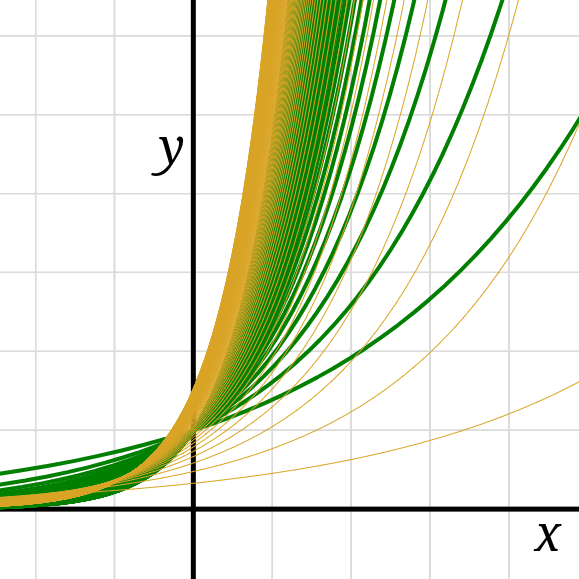
 The derivative of \(\mathrm{e}^x\) is \(\mathrm{e}^x.\)
This is the only function that is its own derivative.
The derivative of a general exponential function with base \(b\)
can be determined from this fact and the chain rule,
since \(b^x = \mathrm{e}^{\ln(b)x}.\)
Altogether,
\[
\frac{\mathrm{d}}{\mathrm{d}x}\biggl( \mathrm{e}^x \biggr) = \mathrm{e}^x
\qquad\text{ and }\qquad
\frac{\mathrm{d}}{\mathrm{d}x}\biggl( b^x \biggr) = \ln(b)b^x
\]
This is the reason we describe exponential functions
as “growing at a rate proportional to their current value”;
they are the only functions \(f\) for which \(f'(x) = kf(x).\)
The derivative of \(\mathrm{e}^x\) is \(\mathrm{e}^x.\)
This is the only function that is its own derivative.
The derivative of a general exponential function with base \(b\)
can be determined from this fact and the chain rule,
since \(b^x = \mathrm{e}^{\ln(b)x}.\)
Altogether,
\[
\frac{\mathrm{d}}{\mathrm{d}x}\biggl( \mathrm{e}^x \biggr) = \mathrm{e}^x
\qquad\text{ and }\qquad
\frac{\mathrm{d}}{\mathrm{d}x}\biggl( b^x \biggr) = \ln(b)b^x
\]
This is the reason we describe exponential functions
as “growing at a rate proportional to their current value”;
they are the only functions \(f\) for which \(f'(x) = kf(x).\)
The derivative of \(\ln(x)\) is \(\frac{1}{x}.\) This makes some sense since a logarithm represents iterated division. The derivative of a general logarithmic function with base \(b\) can be determined from this fact and the change-of-base formula for logarithms, \(\log_b(x) = \frac{\ln(x)}{\ln(b)}.\) Altogether \[ \frac{\mathrm{d}}{\mathrm{d}x}\biggl( \ln(x) \biggr) = \frac{1}{x} \qquad\text{ and }\qquad \frac{\mathrm{d}}{\mathrm{d}x}\biggl( \log_b(x) \biggr) = \frac{1}{\ln(b)x} \]