-
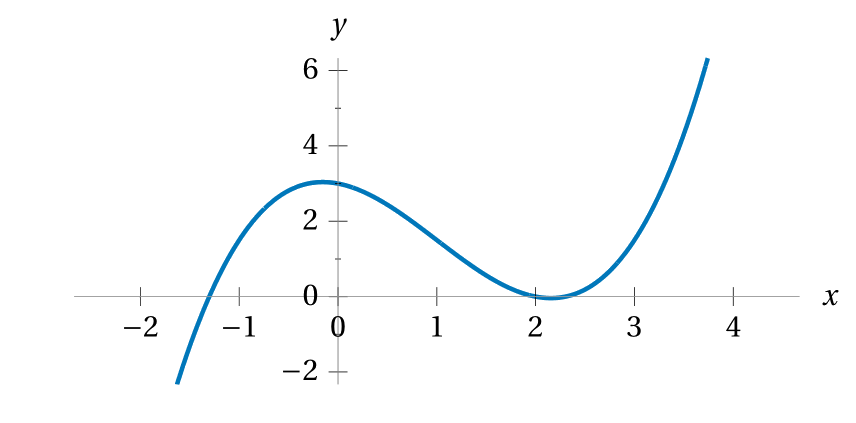
Below is the graph of a function \(f.\) Estimating from the graph, what is the value of \(f(3)?\) What is the value of \(f(0)?\) For what value(s) of \(x\) does it appear \(f(x) = 0?\)
-
Here’s a table of some input/output pairs of a function \(\ell.\) What is the value of \(\ell(4)?\) What is the value of \(\ell(-1)?\) For what value(s) of \(x\) does \(\ell(x) = 0?\)
input \(x\) -5 -4 -3 -2 -1 0 1 2 3 4 5 … output \(\ell(x)\) 0.03 99 18 0 341.1 -90 6013 -6 0 3.1415 420 … - A function \(M\) is defined explicitly in terms of a formula, \(M(x) = x^3 - 10x^2 + 7.\) What is the value of \(M(3)?\) What is the output of \(M\) corresponding to an input of \(-1?\)
-
This table of input/output values
supposedly describes a function \(f,\)
but there’s a problem. What’s the problem?
Explain why \(f\) isn’t really a function.
input \(x\) -1 4 -3 -9 1 0 12 -7 3 4 … output \(f(x)\) 1 17 -5 31 -9 12 5 5 43 9 … -
At noon every day for the first two weeks of January,
Clapton weighed himself and recorded his weight (in lbs)
in the table below.
Day 1 2 3 4 5 6 7 8 9 10 11 12 13 14 Weight (lbs) 177 177 176 177 176 174 174 173 174 174 173 170 172 171 - How much did Clapton weight on the 11th day of the month?
- On what day(s) did Clapton weight 174lbs?
- How much total weight (net weight) did Clapton lose?
- Over the duration, what was Clapton’s average weight loss per day? (be careful: only thirteen days elapsed between the first and last measurement!)
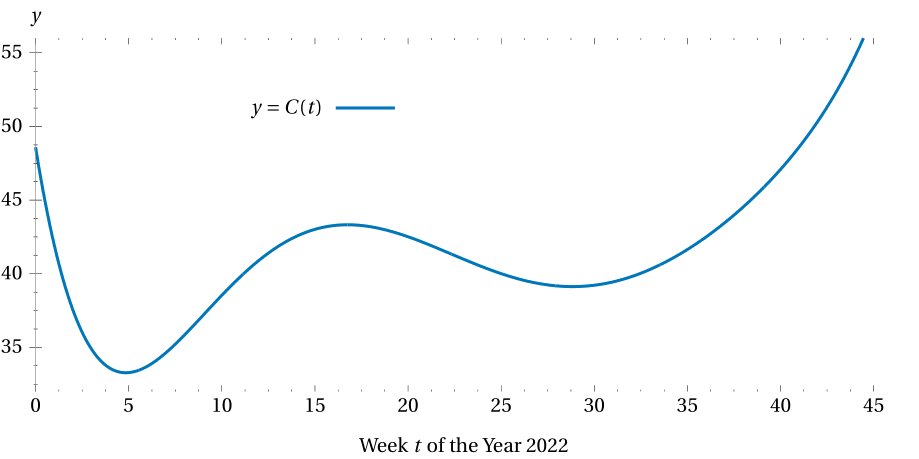
- The domain of the model \(C\) is \(0 \lt t \leq 44.\) What is the range of the model?
- Estimating, what is the value of \(C(17)?\) What does this value mean in this context?
- Estimating, after which week(s) of 2022 did the price of one share close at about $42?
- Estimating, after which week(s) of 2022 did the closing share price increase?
If a ball is thrown into the air with an initial upward speed of 17 meters-per-second, its height (in meters) measured \(t\) seconds after being released can be modelled by the function \[ h(t) = 1.8 + 17t - 4.9t^2 \,. \]
- What is the value of \(h(1),\) and what does this value mean in the context of the model?
- What is the height of the ball three seconds after being thrown?
- When the ball falls back down and hits the ground, its height will be zero meters. Test the model with other input values to estimate how long after being thrown the ball will hit the ground.
- Test the model with other input values to estimate the highest the ball gets.
- Use technology to generate a graph the function \(h\) and answer the previous two questions visually based on the graph.
Puzzle
Two brothers ran a hundred-meter race, and the older brother won by three meters. In other words, when the older brother reached the finish line, the younger brother had run ninety-seven meters. They decided to race again, this time with the older brother starting three meters behind the starting line. Assuming that both boys ran the second race at the same speed as the first race, was the second race a tie? Or did one of them win?