When we say “numbers” we mean the real numbers, all the infinitely-many numbers on the real number line. This includes the integers (whole numbers) and rational numbers (fractions), as well as all the more exotic numbers in between.

An interval is a contiguous (connected) subset of the real numbers.
If \(a \lt b,\) the interval \([a,b]\)
is the set of all numbers between \(a\) and \(b,\) including \(a\) and \(b\) themselves.
This interval could also be described in terms of an inequality
as all numbers \(x\) such that \(a \leq x \leq b.\)
The numbers \(a\) and \(b\) are called the endpoints of the interval.
If we want to talk about the same interval but excluding the endpoints,
we denote it \((a,b);\)
this is all numbers \(x\) such that \(a \lt x \lt b.\)
 To distinguish between these two types of intervals,
we refer to \([a,b]\) as a closed interval
and \((a,b)\) as an open interval.
When sketching an interval on the real number line,
conventionally we indicate an included endpoint with a filled-in circle like ⚫︎
and an excluded endpoint with an empty circle like ⚪︎.
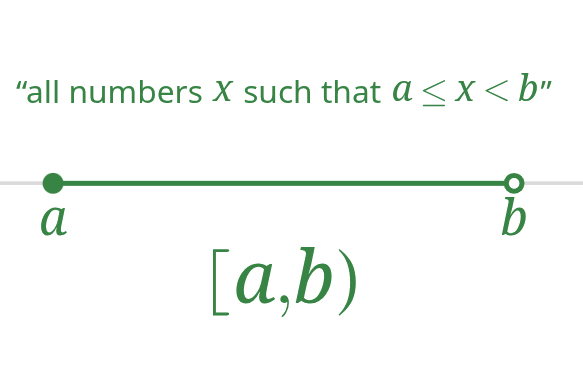
If we’d like to include one endpoint but not another,
we could write an interval that is half-open
(or half-closed) like \([a,b)\) or \((a,b].\)
If an interval doesn’t have an endpoint on a side,
but instead extends towards positive or negative infinity,
we can denote this with the symbol \(\infty\) or \(-\infty.\)
E.g. the interval \([a, \infty)\) denotes
To distinguish between these two types of intervals,
we refer to \([a,b]\) as a closed interval
and \((a,b)\) as an open interval.
When sketching an interval on the real number line,
conventionally we indicate an included endpoint with a filled-in circle like ⚫︎
and an excluded endpoint with an empty circle like ⚪︎.
If we’d like to include one endpoint but not another,
we could write an interval that is half-open
(or half-closed) like \([a,b)\) or \((a,b].\)
If an interval doesn’t have an endpoint on a side,
but instead extends towards positive or negative infinity,
we can denote this with the symbol \(\infty\) or \(-\infty.\)
E.g. the interval \([a, \infty)\) denotes all \(x\) such that \(x \geq a\)
.
Such intervals must be open on the infinite side.
The interval \((-\infty, \infty)\) denotes the whole real number line.